

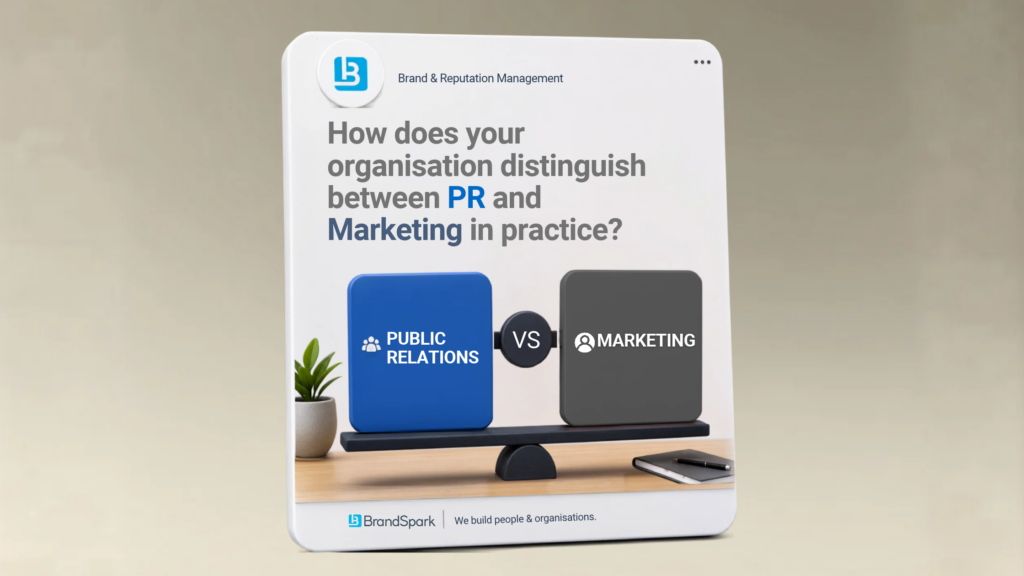
Recently, someone asked me: ‘How does your organisation distinguish between PR and marketing in practice?’
I didn’t respond from my organisation’s perspective, but what I believe should be the perspective of corporate organisations. Here’s what I said:
The organisation should distinguish between PR and marketing by first acknowledging that, while there’s an intersection, they are distinct, and while they utilise the same media channels, the objective is what points to whether it was marketing at work or PR.
For instance, an organisation can run an Instagram ad to generate leads; that’s marketing. The same organisation can boost educational content on Instagram to reach a wider audience and influence changes in behaviour; that’s PR. In both instances, the organisation has used the same channel, but the goal was different.
In addition, management must recognise that there are certain goals which are better achieved through marketing and vice versa, rather than trying to force PR into the marketing mould. Doctors and pharmacists both help a patient heal, but a pharmacist cannot perform surgery. It’s the same with PR and marketing.
Both functions may interact with customers, but what each one is able to deliver differs. If you cannot force a pharmacist to perform surgery, you shouldn’t make certain demands of PR. Sometimes PR will deliver sales; sometimes it will not. The business does not call on marketing to manage crises; it should be the same with driving sales.
I deliberately chose the icons that represent both functions in the graphic. That’s because while the customer is the focus of the marketing function, public relations interacts with all of the organisation’s stakeholders, including the marketing department and the customers/ consumers it serves. This is the intersection between PR and marketing. However, its scope and applicability are far wider.
PR works with the business leadership to ensure that the organisation has a good relationship with its various stakeholders, namely: consumers, community, employees, investors, and government, and earns their trust. Public relations also shapes reputation, builds credibility, and creates goodwill for the business’s sustainability. On the flip side, marketing identifies customers’ needs, designs products to satisfy them, promotes them to drive purchases and builds programmes that drive repeat purchases for the business’s sustainability.
In the course of its work, PR may implement programmes, one of which may be marketing communications campaigns. This is where PR and marketing intersect. PR builds the credibility that facilitates sales because customers buy from trusted brands. The function also defends the brand in a crisis to restore trust.
However, the relevance of PR extends beyond commercial or for-profit organisations. While the government does not have products to market, it needs to build trust with the citizens. Similarly, a non-profit needs to demonstrate its impact to reach donors. This is hardly achieved through marketing tactics, but through PR tactics.
One of my favourite quotes attributed to former Apple executive Jean-Louis Gassée says it all: ‘Advertising is saying you’re good. PR is getting someone else to say you’re good.’
This is how we distinguish between public and marketing in practice.