
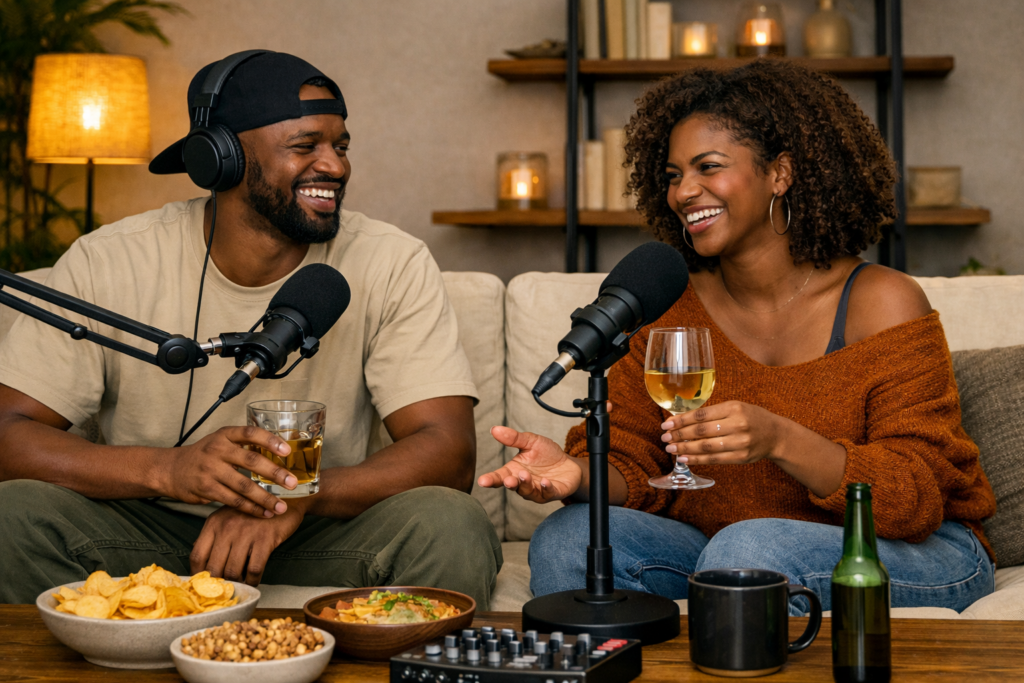
Almost anyone can start a podcast and talk about just anything. You do not have to be a journalist. A person, a couple, or a few people sit across from each other at a table with microphones, conversing, and you have a podcast.
In some instances, the podcasts are cosy. The hosts and guests sit on sofas. They have drinks and snacks. They’re not uptight like in a television or radio studio. What could go wrong?
The lack of barriers to entry in podcasting is one reason for its popularity. Podcasts are increasingly competing with traditional television and radio interviews, which are gatekept. They do not operate by stringent traditional media rules, such as fixed airtime slots, because they live on digital media. A session can run for five minutes or three hours. The benefits that accrue to digital media, including wider reach, measurable engagement, and access to analytics, have also made podcasts an important element of the media mix and a publicity vehicle.
However, because of the relaxed settings, guests let their guard down and may unconsciously make statements that expose them to reputational risks. Let’s consider a few events.
David Oyelowo on One54 Africa
David Oyelowo was a guest on One54 Africa, a podcast hosted by Akbar Gbajabiamila and Godfrey Danchimah that spotlights the untold stories of African entertainers, athletes, and business leaders. In the very heartfelt conversation, Oyelowo spoke about growing up between the UK and Nigeria, attending boarding school, idiosyncrasies of Nigerian parents, his acting career, and business.
They sampled Nigerian food, such as Chin Chin, Puff Puff, Akara and Pap. They had a good laugh. He was at home. Then, at the tail end of a truly enjoyable episode, while mimicking accents, he made a comment which upset some African Americans. He has since apologised.
Iyin Aboyeji on Afropolitan
Iyin Aboyeyi, though highly regarded by many Nigerians, also recently faced backlash for comments made during a podcast appearance. An old clip of Aboyeji on the Afropolitan podcast hosted by Chika Uwazie and Eche Emole resurfaced and went viral. In the clip, he suggested that President Tinubu was shielded from the news. Mainstream media picked it up, with Nigerians pulling up a speech by the President, where he shared his experience of reading and listening to the news. Aboyeji has also apologised.
Anthony Albanese on Bush Deep
The Australian prime minister, Anthony Albanese, on the Bush Deep podcast hosted by comedian Nikki Osborne, is another example. While on the show, Osborne asked the Prime Minister whom he would ‘shag, marry, date’ among pop singer Kylie Minogue, actor Nicole Kidman, and entertainer Rhonda Burchmore.
He initially declined to answer, stating that he was newly married and ‘only six months in’.
Then the host said, ‘But if it goes tits up, let’s just pretend.’
He obliged, nominated Kylie Minogue for all three categories, and said, ‘She is terrific.’
Politicians and the public were outraged. His statement was considered disrespectful of women and unbefitting of the office of Prime Minister, so he apologised.
I had to look up the meaning of ‘if it goes tits up’ to understand why the Prime Minister caved in. According to the AI overview, ‘It is a British and Australian slang that means something has gone completely wrong, failed, or broken down.’ So, he probably thought that since it was a hypothetical question, his response wouldn’t mean much; after all, it was just a game.
***
All three interviews had two things in common: the atmosphere was relaxed, and the hosts weren’t journalists. Public figures work with public relations professionals to manage their reputation. As a result, there’s a high likelihood that these personalities have undergone media training.
Had they been sitting with a journalist, whether on television or a podcast, they would have likely been more guarded. This is because they’re trained to understand the psychology of journalists. They expect journalists to ask tough questions, and they know that with journalists, nothing is off the record. They would have had dry runs, considering the stakes of a slip-up.
But when you’re just having friendly banter with a comedian or an industry colleague, it’s easy to let your guard down, and the probability of making an error becomes higher, especially when you’ve been speaking for three hours. That’s the risk. So, contrary to popular beliefs that you should be more relaxed on a cosy podcast, you should be even more guarded.
As I often argue, public relations hasn’t changed; the media landscape has just evolved. So whether it is a radio, television, or podcast interview, the old rules still apply. Remember your interview etiquette. Anything you say or do may be used against you in the court of public opinion, so don’t let your guard down!
References
https://www.bet.com/article/g0p0as/david-oyelowo-apologizes-for-linking-black-southern-accents-to-slavery-and-subservience
https://businessday.ng/technology/article/presidential-isolation-is-nigerias-biggest-governance-risk-flutterwave-co-founder/
https://www.linkedin.com/feed/update/urn:li:activity:7479937164210982913/
https://time.com/article/2026/07/06/anthony-albanese-australia-prime-minister-apologizes-shag-kylie-minogue-controversy/
https://www.theguardian.com/australia-news/2026/jul/06/anthony-albanese-apologises-kylie-minogue-podcast-comment